• About
  • Blog
  • Contact

Puah And Shifra: The Power of Allies

4/23/2014

1 Comment

 
Picture
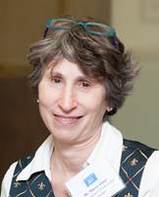
By Marya Axner

Reprinted from the Jewish Journal, April 11th

Puah and Shifrah are my two favorite characters in the Passover story, and they have a particular relevance to my work at the New England Jewish Labor Committee.

In the Passover story, Pharoah feels threatened by the Jewish people in his land. He decides there are too many of them, and he sets a policy of decreasing their numbers. He orders the Egyptian midwives to kill every Jewish male child that is born. Puah and Shifrah, two midwives, refuse to go along with the Pharaoh’s orders. They say it is impossible to carry them out because the Jewish women have their babies quickly, before they can arrive.

Puah and Shifrah have chosen the role of being allies. Allies are people who are not directly targeted by an oppressive ruler or oppressive society, but choose to take a stand on behalf of others who are being targeted.

We have all experienced what it is like to be treated badly. We are targeted at some point in our lives, or throughout our lives, as working people, people of color, women, Jews, young people, LGBT people, differently-abled people, and all the other groups I haven’t mentioned. And at the same time, we are members of groups that are not directly targeted. We have a choice as to whether we want to be allies, bystanders, or whether we want to carry out the orders of the oppressive rulers.

What was it like for Shifrah and Puah to go against the Pharoah’s orders? They took some risk. Did they trust each other enough not to turn each other in? They decided not to go along with the lies of an oppressive society, but instead, turned their hearts, minds and whole beings against the force of oppression. They had to look into themselves and decide it was more important not to sell out their own humanity. In doing so, they were standing up for themselves, as well as for the Jews.

In my position at the New England Jewish Labor Committee, I am lucky to work with the Jewish community to stand up for all workers — Jewish or not.

I have the privilege of being an ally. And as a Jew and a worker, I know what it is like to depend on allies. In Albania, Bulgaria and Denmark, Jews were saved by allies during World War II. In the Chicago neighborhood where I grew up, most of our neighbors told their children not to play with my brother, sister and me because we were Jewish. However, one family who lived next door broke from the neighborhood code and befriended us. This meant everything to my family.

If we can all figure out how to be allies, we could turn this society around in short order. We could change everything.

Marya Axner is the Regional Director of the New England Jewish Labor Committee.
1 Comment

The Common Good

4/7/2014

0 Comments

 
Picture
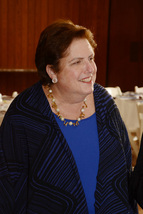
By Joanne Goldstein

I feel so fortunate to be able to have a career that combines my Jewish values with my commitment to economic and social justice. I began as the first female union-side labor lawyer in Boston.  I knew I had the job when I received my interview reimbursement check with the memo line: “girl to be hired.” For so many years I represented and fought for working people, initially as a lawyer for local unions and employees and then as General Counsel for a national union. Seven years ago I entered state government as chief of Attorney General Martha Coakley’s Fair Labor Division and, most recently, as the Secretary of Labor and Workforce Development under Governor Deval Patrick for the Commonwealth of Massachusetts.  I will shortly move on to a new and exciting opportunity—at Northeastern University as Associate Vice President for Workforce Development and Employer Engagement.  There I will focus on employability of college graduates, to help insure that the next generation has meaningful, family sustainable employment as well as a superb education. 

How did I take this pathway? I come to it naturally. The answer is embedded in my family background--in its Judaism, its politics and its culture. My father was a student activist in New York City during his younger years and deep into their old age I knew some of his fellow activists. Amidst unprecedented social dislocation and gathering foreign storm clouds they fought for a fairer, more compassionate America.  He was also a proud, committed Jew. My mother helped Jewish refugees from Egypt and, later, immigrants from the USSR.  She volunteered tirelessly for the National Council of Jewish Women and instilled in her children the ethic to count our blessings and make sure to give back.

We were a fully engaged Jewish household.  When we celebrated Passover and Hanukkah, we stressed their lessons of freedom and justice for all.  On Yom Kippur (Day of Atonement) when we prayed for forgiveness, we included the sins of overweening pride, covetousness and indifference.

I was also a child of the ‘60’s, of that singular era of social, political and cultural revolt in American life, largely fueled by African-Americans of all ages and by the youth of various races and backgrounds.  In that milieu I learned my labor history and the importance of unions.  I learned “who gave us the weekend.”  I learned that you have to struggle to bring about racial, social and economic justice.  I learned not long after that, when I appeared in court for my clients, that it was not acceptable to me when judges called me “honey” from the bench.

I married a man who had parallel beliefs and passions, who shared in taking care of our kids and the house so I could pursue my passions.  He carried our kids on his shoulders to visit me on the picket lines so they could see what a just struggle is and what their mother was all about.

I know that the Jewish Labor Committee was in Roosevelt’s Democratic coalition and how it contributed to electing President John F. Kennedy.  I heard about its effectiveness – comparable or even greater than that of other, larger Jewish organizations – in trying to save Jews from the Nazis.  I learned of its longtime relationships with unions and social justice organizations.  I learned to respect the JLC and to cherish its existence. I have been a member for decades.

The labor movement is one of the institutions in our society that can look beyond its own self-interest and work for the common good.  Here in Massachusetts, I was gratified serve as Labor Secretary to safeguard the place of unions at the table during times of governmental and economic reform. Unions are still built on integrity, community and a willingness to provide a voice for those without one.

How gratifying that my Judaism has provided me with the value system and the platform to pursue a career consistent with those values and beliefs, and to live an honorable life.  

Joanne Goldstein is the Former Secretary of Labor and Workforce Development for the State of Massachusetts.  A Massachusetts native, she has spent her entire professional career fighting for the interests of working men and women across the Commonwealth and the nation. She is currently working for at Northeastern University as Associate Vice-President of Workforce Development and Employer Engagement in the College of Professional Studies.

0 Comments

In the Divine Image

3/19/2014

1 Comment

 
Picture
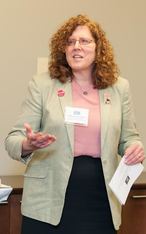
By Rabbi Barbara Penzner

Perhaps it was reading in the Torah about God's compassion for the Hebrew slaves. Perhaps it was hearing the prophets exhorting the people to treat everyone justly. Perhaps it’s the history of Jews who helped shape the US labor movement that is in my bones. I’ve never belonged to a union and I’ve never been arrested. I stood in my first picket line outside the Hyatt Regency in Cambridge just three years ago. Now I notice workers who used to be invisible to me: the housekeepers who change the sheets in my hotel room, the migrant workers who pick the tomatoes in my salad, the hospital staff who keep patients clean and comfortable. More than ever, I am committed to using my cherished Jewish values to improving the lives of everyday workers .

Norman Thomas. Eugene V. Debs. Martin Luther King, Jr. These were names I heard in my home growing up in the 1960s. Not many kids growing up in the suburbs of Kansas City heard their parents talk of socialists, union leaders and civil rights leaders (at least, not in positive terms). My father voted for Norman Thomas, the Socialist candidate for president, for many years before becoming an ardent supporter of the Democratic Party. I know he had a lump in his throat when he and my mom registered as Republicans in Kansas in order to have any voice in the political process in a state that was red long before we talked about politics in primary colors.

My parents were not rabble-rousers. The most shouting I ever heard was my mother shouting at the TV during the news. But they talked about politics at home, in “Great Decisions” groups, and often at the Passover Seder, which my father, an avowed atheist, led every year. He taught me, and my three siblings, the importance of participating in the political process: voting, campaigning and advocacy.

Today, Jews are well-represented in political circles and are leaders in advocating for many social justice causes.  Name an issue on the liberal agenda, and there’s a Jewish organization working on it: fighting poverty in America and abroad, ending gun violence, fighting human trafficking, supporting civil rights, reforming health care and many more.

The one issue that falls off the table among Jewish groups today is labor. While many Jewish groups support those in need, the Jewish community has only one organization that consistently stands for the rights of workers: The Jewish Labor Committee. I am proud to be a leader and supporter of the New England Jewish Labor Committee.
I often wonder what happened to the Jewish commitment to organized labor. After all, Jews were prominent in the labor movement for much of the early twentieth century. Many of us remember parents and grandparents who worked in the trades, built the unions and fought for child labor laws and the forty-hour work week. What has changed?

One important shift is that more Jews are managers today than laborers. But that shouldn’t keep us from caring for workers. Costco, a Jewish-owned corporation, has demonstrated that there’s good business sense in treating workers fairly.  

I would argue that fewer people in management have relationships with the people who work for them, knowing who their families are and what their lives are like. If we did, I believe that more Jews would want to support fair labor practices to help working people succeed as our parents and grandparents did.

In today’s financial climate, many businesses are owned by multi-national corporations who have no relationships with their janitors, hospitality or security workers. Just as these management companies are faceless to us, their workers are invisible to the people who run them.

That’s what made two victories for hotel workers in 2014 so exceptional. In July, Hyatt Hotels reached an agreement with hotel workers across the nation (with some exceptions, including the three Hyatts in Boston and Cambridge, still under boycott). That agreement ended a year-long global boycott of the Jewish-owned hotel chain. In December, the year-long boycott of Le Meridien Hotel in Cambridge ended with an historic agreement with HEI Hotels investment group. In both cases, large corporations with no personal connection to their lowest-paid employees decided to give the workers a place at the table. The Jewish Labor Committee played an active role in both victories.

My father also taught me what I came to understand later as a basic organizing principle: the power of relationships. My dad knew how to tell a joke to make people comfortable. Then he would draw them out, listening warmly and intently. He was better at selling than at any other aspect of running a business, because he thrived on relationships—with his distributors, colleagues, and his employees. And he treated them all fairly. For him, this was a way to live his Jewish values.

Likewise, Aaron Feuerstein, who was lauded for continuing to pay his employees after a devastating fire at the Malden Mills textile factory in Lawrence in 1995, insisted that his Jewish upbringing compelled him to treat his workers with justice and compassion, saying:.

I have a responsibility to the worker, both blue-collar and white-collar. I have an equal responsibility to the community. It would have been unconscionable to put 3,000 people on the streets and deliver a deathblow to the cities of Lawrence and Methuen. Maybe on paper our company is worthless to Wall Street, but I can tell you it's worth more.

As we teach in the Jewish tradition, all human beings are created b’tzelem Elohim, in the divine image. That means that we are not only equals, we are equally responsible for each other’s welfare, for the people who clean our hotel rooms, pick our fruit, throw out the garbage in our offices, teach our children, care for our elders, or do any number of jobs that make our lives comfortable. It’s a Jewish moral imperative.

That’s why I support the Jewish Labor Committee.

Rabbi Barbara Penzner is the incoming Co-Chair of the New England Jewish Labor Committee. She serves as rabbi of Temple Hillel B'nai Torah in West Roxbury, Massachusetts, a Reconstructionist congregation. In 2011, Rabbi Penzner was honored as a Rabbinic Human Rights hero by T'ruah, the Rabbinic Call for Human Rights, for her advocacy on behalf of Hyatt workers.

1 Comment

Welcome to Kolot

3/19/2014

0 Comments

 
WELCOME TO THE KOLOT PROJECT

Marya Axner* and David Seligman**

The Kolot Project  (or the “Voices Project”) is a forum for New England’s Jewish community to think, discuss, and advocate for workers' rights and empowerment.  

For nearly a century, the Jewish Labor Committee has served as the “Jewish voice in the labor movement and the labor voice in the Jewish community.”  But this task is much different -- and much more complicated -- than it once was.  The low- and middle-wage workforce is spread across increasingly diverse industries and faces increasingly complex challenges -- wage theft, immigration difficulties, student loans, and long term underemployment, to name just a few.  Meanwhile, the Jewish community is more dispersed and diverse than it has ever been.  We confront workplace issues as workers, consumers, employers, and community leaders.

The Kolot Project will ensure that these voices come into conversation to build awareness and spur action.  New England’s Jewish community has often been at the forefront in the fight for a fair and just workplace, and we want to make sure that this community maintains and builds on this history.  

The Kolot Project will be comprised of bi-weekly “guest posts” from a variety of people who provide a unique and important voice on issues at the intersection of Judaism and worker’s rights.  We expect posts from workers, employers, labor organizers, and political and religious leaders.  

In terms of content, our posters will have broad discretion to craft their own messages.  We will merely direct them to speak from the heart about their Judaism and workers’ rights, either in an abstract sense or with concrete references to current developments in the labor or Jewish worlds.  Some of these voices are likely to make specific “asks” or calls to action, while others may ask us to ponder an injustice in our community through the lens of Jewish culture and beliefs.  Our New England Jewish Labor Committee community, and our New England labor community more generally, are full of thoughtful and compelling voices, and we hope that compiling these voices in a single place will lead to conversations within the Kolot Project forum and in synagogues and community centers around the region.

We encourage you to share our link with friends and family, sign up for an RSS feed, and follow us on twitter.  Many of us think and work on social justice issues, but it’s rare that we have an opportunity to focus, in particular, on workers’ issues.   This hasn’t always been the case.  Labor and workers’ rights have been the focus of our tikkun olam, and whether or not you’ve thought about these issues before, we encourage you to be part of our conversation.

*Mary Axner is the Regional Director of the New England Jewish Labor Committee

**David Seligman is a public-interest lawyer working on behalf of low-income consumers and workers.  He is a New England Jewish Labor Committee volunteer. 

0 Comments
Forward>>

    Archives

    July 2018
    September 2017
    April 2017
    February 2017
    October 2016
    August 2016
    June 2016
    May 2016
    March 2016
    November 2015
    October 2015
    September 2015
    March 2015
    January 2015
    November 2014
    July 2014
    June 2014
    May 2014
    April 2014
    March 2014

    Categories

    All

    RSS Feed

    Enter your email address:

    Delivered by FeedBurner

Powered by Create your own unique website with customizable templates.
